
The True Cost of HubSpot Implementation & Optimization (2026 Partner Pricing Guide)
Investing in HubSpot is often framed around license fees—whether choosing Starter, Professional, or Enterprise tiers. However, software licensing represents only half of the total cost of ownership. The true driver of revenue acceleration is implementation architecture: structuring custom pipelines, configuring lead routing logic, ensuring bi-directional ERP data syncs, and training go-to-market (GTM) teams.
When scoping a rollout, organizations face distinct cost tiers based on data complexity, automation scope, and enterprise system integration.
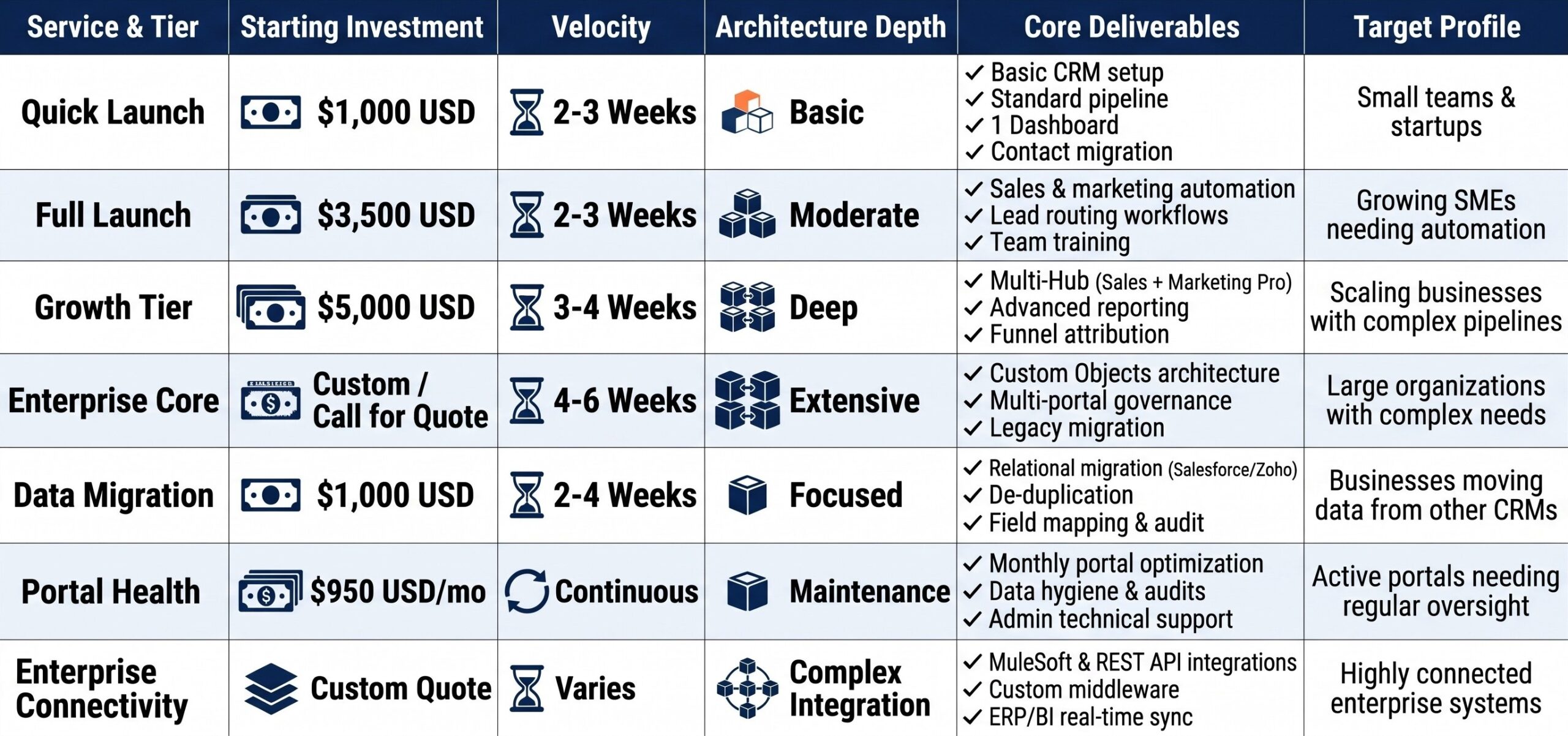
2026 HubSpot Implementation & Management Cost Matrix
The following breakdown outlines the real-world investment required across initial onboarding, CRM migration, enterprise connectivity, and continuous optimization:
What Determines Your Actual HubSpot Implementation Costs?
Implementation pricing is shaped by four technical dimensions:
1. Data Schema Complexity & Migration Volume
Moving flat CSV contact lists into a CRM is simple; migrating relational databases containing multi-year deal histories, custom ticket attachments, and parent-child company associations is not. CRM data migrations starting at $1,000 focus on eliminating duplicates, restructuring unstandardized picklist properties, and mapping data fields accurately before importing them into HubSpot’s data engine.
2. Multi-Hub Alignment (Sales, Marketing, Service, Operations)
Deploying a single hub (e.g., Sales Hub for deal tracking) requires basic pipeline logic and deal stages. Conversely, deploying a synchronized suite across Marketing Hub (lead capture, email nurturing, attribution modeling), Sales Hub (automated sequences, quoting), and Service Hub (ticketing SLAs, customer portals) demands unified lifecycle stage automation so contacts transition seamlessly without duplicate triggers.
3. Enterprise Connectivity & Custom Integrations
Native marketplace apps cover standard syncs for tools like Slack or Google Workspace. However, connecting HubSpot to proprietary ERPs, custom billing engines, or specialized warehouse platforms requires advanced integration solutions. Using middleware such as MuleSoft or developing custom API endpoints ensures bi-directional data flow, transactional parity, and real-time record synchronization.
4. Custom Objects & Security Governance
Standard objects (Contacts, Companies, Deals, Tickets) do not always fit every operational model. B2B, SaaS, and financial services organizations frequently require Custom Objects (e.g., Subscriptions, Policies, Assets, Inventory). Building custom objects, setting granular team permissions, and establishing audit logging add architectural layers covered under Enterprise packages.
Direct Software Onboarding vs. Certified Implementation Partner
HubSpot mandates direct onboarding fees for new Professional and Enterprise subscriptions. While direct vendor onboarding provides basic orientation and platform checklists, a certified Solutions Partner delivers end-to-end operational execution:
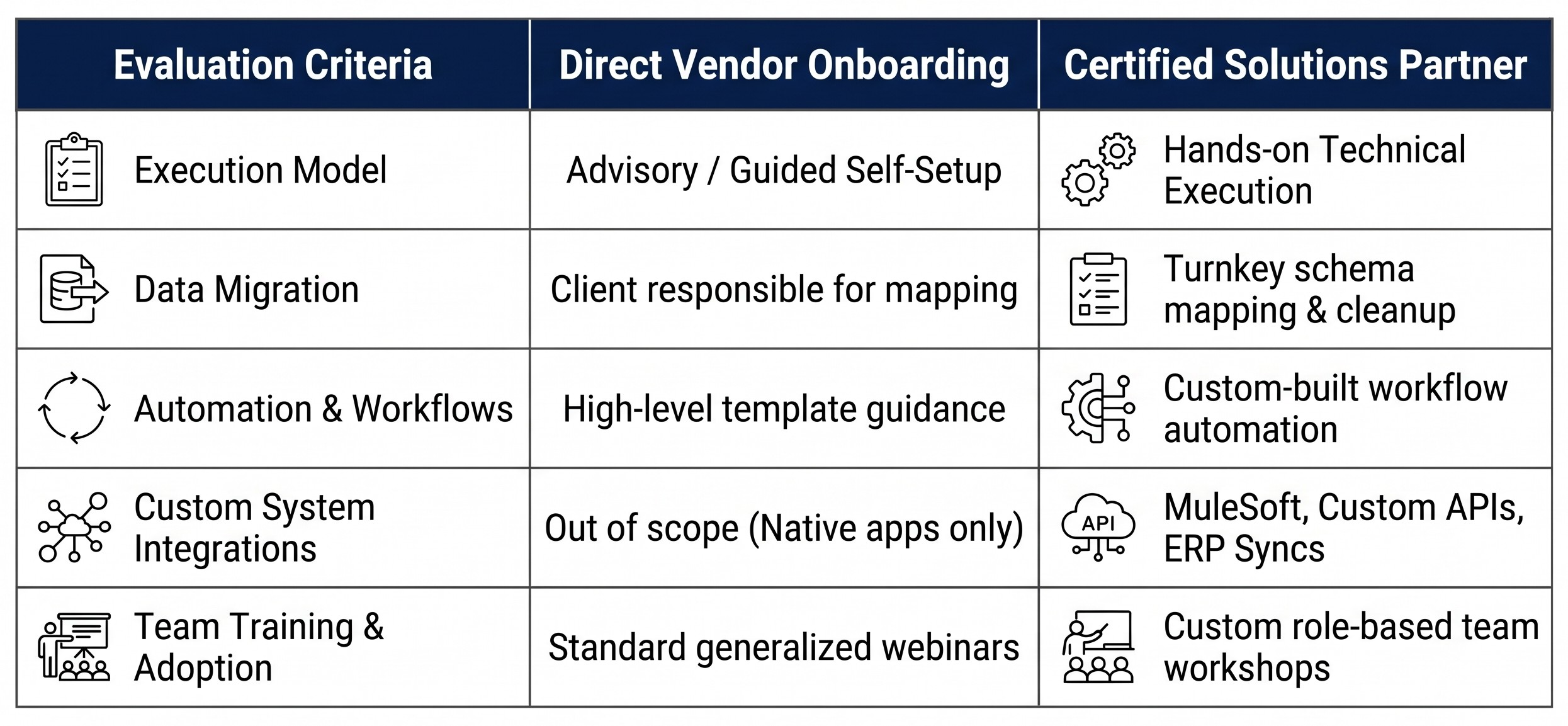
Working with an official Solutions Partner also enables teams to waive direct vendor onboarding fees, reallocating those capital expenditures toward customized portal configuration and team enablement.
Why Ongoing Optimization Matters After Go-Live
Deploying HubSpot is an ongoing investment. Portals naturally degrade over time without proactive governance:
Workflows accumulate duplicate triggers and enrollment errors.
Unused custom properties fragment contact records.
Sales reps bypass mandatory deal stage requirements, distorting revenue forecasts.
Retainer packages—starting at $950/month—function as an external fractional operations engine. Ongoing management guarantees clean database hygiene, regular workflow performance audits, continuous reporting updates, and alignment with new product features released across the HubSpot platform.
Frequently Asked Questions (FAQ)
Can the mandatory HubSpot onboarding fee be waived?
Yes. When purchasing HubSpot Professional or Enterprise licenses through an official HubSpot Solutions Partner, HubSpot permits the standard vendor onboarding fee to be waived, provided the partner delivers equivalent or comprehensive implementation services.
How long does a typical HubSpot implementation take?
Turnkey foundational launches (Quick Launch) typically take 2 to 3 weeks. Comprehensive multi-hub and mid-market deployments (Growth) average 3 to 4 weeks, while complex enterprise architecture rollouts involving custom APIs and ERP migrations span 4 to 6 weeks.
What platforms can be migrated into HubSpot?
Structured data migration packages support migrations from Salesforce, Microsoft Dynamics 365, Zoho CRM, Pipedrive, SugarCRM, and custom SQL databases into HubSpot, preserving historical activities, notes, and relational schemas.
Why choose a specialized regional partner for HubSpot deployment?
Engaging an experienced technical partner in the Philippines and APAC provides high-caliber IT consulting and systems architecture at competitive rates. This delivery model ensures direct access to certified enterprise architects, MuleSoft integration experts, and hands-on GTM operations teams aligned with your working hours.
Ready to Architect Your Revenue Engine?
Whether launching a new portal, migrating legacy databases, or connecting HubSpot to your broader enterprise stack, structure your deployment to scale.
Explore full package details on the Mobius NEXT HubSpot Services & Implementation Directory.
Schedule a discovery consultation to evaluate your data architecture and implementation scope.
Ready to scope your HubSpot investment?
Get a fixed-scope quote for your CRM data migration, multi-hub rollout, or enterprise integration. Explore our HubSpot implementation services, integration & API solutions, and optimization & support, or book a discovery call with Mobius NEXT.