HubSpot Service Hub vs. Zendesk: Which is the Right Customer Support Platform for You?
The Modern Customer Support Challenge
Customer expectations in 2026 have moved past “fast response times.” Today, your customers expect you to know exactly who they are, what they bought last Tuesday, and why they were frustrated with their last marketing email—all before your agent says “hello.” A siloed ticketing system is no longer just an inconvenience; it is a revenue leak.
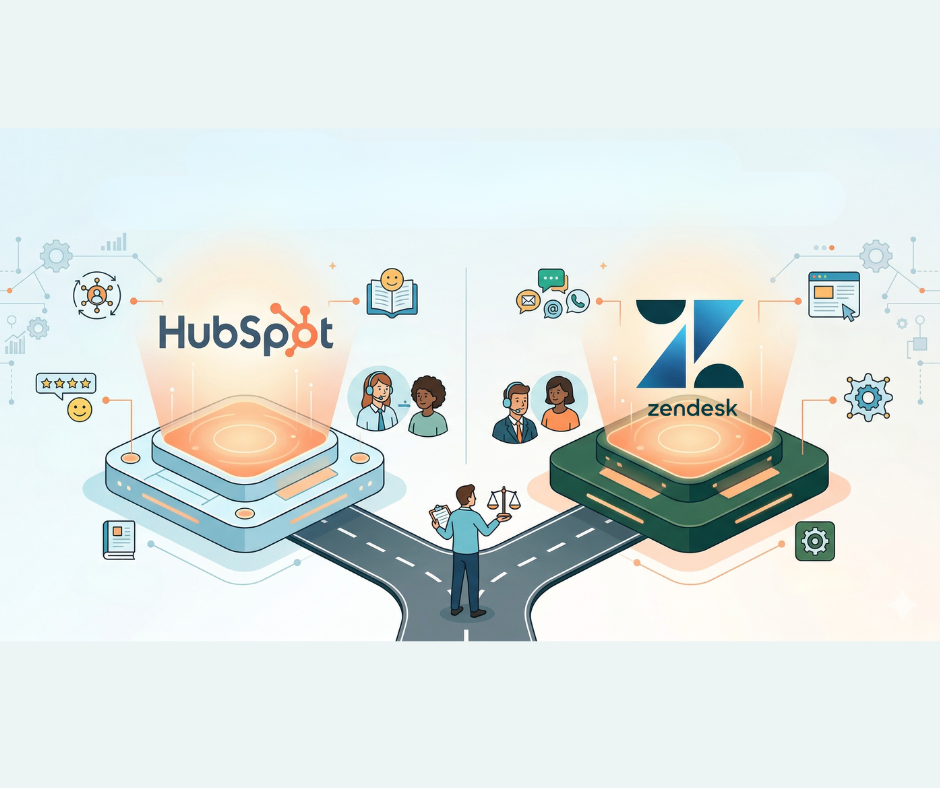
To meet this demand, two titans dominate the landscape: HubSpot Service Hub and Zendesk.
HubSpot is the “Platform” player, offering a unified database where your marketing, sales, and service data live under one roof.
Zendesk is the “Specialist,” a purpose-built powerhouse that has defined help desk excellence for nearly two decades.
Choosing between them isn’t about finding the “better” software; it’s about choosing the right philosophy for your team’s growth. This guide breaks down the technical DNA, the hidden costs, and the ideal use cases for each.
At a Glance: Quick Comparison Table
| Feature | HubSpot Service Hub | Zendesk |
| Best For | Scaling teams seeking a unified CRM & Support view. | Complex, high-volume, enterprise support desks. |
| Core Strength | Native 360-degree customer context. | Advanced ticketing logic & customization. |
| Ease of Use | High (Intuitive, HubSpot-standard UI). | Medium (Powerful but requires a specialist). |
| Data Structure | One unified database across all “Hubs.” | Support-centric (Requires syncs for CRM data). |
| AI Integration | Embedded across the whole GTM journey. | Support-specific (Agents & Answer Bots). |
Deep Dive: HubSpot Service Hub
HubSpot Service Hub isn’t an isolated tool; it is a vital organ in the HubSpot “Flywheel.” It is built on the premise that customer service is just “Marketing after the sale.”
Key Strengths & Advantages:
The Unified CRM Edge: This is HubSpot’s “Unfair Advantage.” When an agent opens a ticket, they see the exact marketing emails the customer clicked and the specific notes the sales rep left during the closing call. There are no “data silos” to bridge.
Frictionless Adoption: If your team already uses HubSpot for Sales or Marketing, the learning curve for Service Hub is zero. The interface is identical, which slashes onboarding time and administrative overhead.
Full-Funnel Reporting: HubSpot allows you to tie support health to revenue. You can easily report on “How many tickets did our highest-value customers open this month?” or “Does a high CSAT score lead to a higher upsell rate?”
Integrated Self-Service: HubSpot’s Knowledge Base and Customer Portal are natively linked to your CRM, allowing you to personalize the self-service experience based on the customer’s tier or industry.
Potential Weaknesses:
Niche Complexity: While it handles 95% of use cases, enterprise teams with extremely complex, multi-layered ticket routing requirements might find Zendesk’s “triggers and macros” engine more flexible.
The “All-In” Commitment: To get the most value, you really need to be using the rest of the HubSpot ecosystem. As a standalone tool, it loses some of its connective magic.
Deep Dive: Zendesk
Zendesk is the industry pioneer. It was built from day one to do one thing: manage support tickets at massive scale.
Key Strengths & Advantages:
Best-in-Class Ticketing Logic: Zendesk’s “Triggers” and “Automations” are surgically precise. You can build intricate workflows that route tickets based on language, sentiment, agent expertise, and SLA priority with a level of granularity that few can match.
The Integration Marketplace: With over 1,000+ apps, Zendesk can be “bolted onto” virtually any tech stack. If you use a “best-of-breed” strategy (e.g., Salesforce for CRM, Jira for Dev, Zendesk for Support), it plays very well with others.
Enterprise Scalability: Zendesk is built for thousands of agents. Its reporting engine (Explore) is incredibly deep, offering support-specific metrics like “Agent Occupancy” and “Leveled SLA” reporting that enterprise managers crave.
Advanced AI Bots: Zendesk has invested heavily in “Answer Bots” and AI that can resolve simple queries autonomously, significantly deflecting ticket volume for massive B2C brands.
Potential Weaknesses:
The Integration Tax: Because Zendesk isn’t a native CRM, you often have to pay for (and maintain) integrations to see your sales data. This can lead to “tab-switching fatigue” for agents.
Complexity Overhead: The power comes with a price—complexity. You often need a “Zendesk Administrator” to keep the system optimized, whereas HubSpot can usually be managed by a generalist.
Head-to-Head Feature Comparison
Ticketing & Automation
Zendesk Wins on Power: Its macro system and trigger logic are more advanced for complex support flows.
HubSpot Wins on Context: Seeing the “Sales Context” directly inside the ticket window allows agents to provide a much more personalized service experience.
Reporting & Analytics
Zendesk Wins on Granularity: If you need to know the “average time an agent spent in a ‘pending’ status on a Tuesday,” Zendesk will tell you.
HubSpot Wins on Correlation: If you want to know “which marketing campaign resulted in the most support tickets,” HubSpot is the only one that can tell you without a complex data project.
Live Chat & Chatbots
HubSpot Wins on Accessibility: Their “Chatflows” are incredibly easy to build and the free version is a great entry point for startups.
Zendesk Wins on Sophistication: For high-volume deflection and AI-driven resolution, Zendesk’s bots are currently more “support-aware.”
The Deciding Factor: Who Should Choose Which?
Choose HubSpot Service Hub if…
You are already a HubSpot user. The synergy is too valuable to ignore.
Your priority is Customer Lifetime Value (CLV). You want your sales and service teams to work together to grow accounts.
You are a mid-market company that wants a “total view” of the customer without hiring a full-time system administrator.
Choose Zendesk if…
Support is your primary product (e.g., a high-volume B2C app).
You have a massive, multi-tiered support team with hundreds of agents and complex international requirements.
You use a fragmented tech stack (like Salesforce + Jira + Slack) and need a “best-of-breed” support tool to sit in the middle.
Platform vs. Powerhouse
The choice between HubSpot and Zendesk isn’t about which software is “better”—they are both world-class. It’s about alignment.
Do you want a Deeply Integrated Platform that treats every customer interaction as a single story? Choose HubSpot. Or do you want a Specialized Powerhouse built to crush massive ticket volumes with surgical precision? Choose Zendesk.
The best support tool is the one that removes the friction between your team and your customers. Map your top five priorities today and see which philosophy aligns with your 2026 growth goals.
Book your free 30-minute Service Strategy Audit today
Resources:
HubSpot Knowledge Base – Service Hub Overview: https://knowledge.hubspot.com/service-hub/get-started-with-service-hub
HubSpot Knowledge Base – Migrating from Zendesk to HubSpot: https://knowledge.hubspot.com/reports/import-data-from-zendesk-to-hubspot
HubSpot Knowledge Base – Setting up Customer Portals: https://knowledge.hubspot.com/service-hub/set-up-a-customer-portal
HubSpot Knowledge Base – Service Hub Pricing Guide: https://www.hubspot.com/pricing/service